
PARIS — France’s “unprecedented” deployment of warships to the Middle East is meant to position the country as a credible security partner for the region, a move that could set up the French to benefit from any realignment of alliances following an end to the American-Israeli war on Iran, analysts said.
France has deployed around half its fleet of major surface combatants to the Eastern Mediterranean, including its only aircraft carrier, after Iran struck countries across the Middle East with missiles and drones and closed the Strait of Hormuz. The operation is aimed at protecting navigation, French citizens and France’s allies in the region, President Emmanuel Macron said on Monday.
With Arab Gulf states seeing the United States as an increasingly unreliable partner that started a war against Iran they tried to avoid, the French display of naval power positions the country as an additional security provider, said Laure Foucher, a senior research fellow at the Paris-based Foundation for Strategic Research.
“We’ve been useful partners for the Gulf, but occasionally; we’ve not been able to translate our occasional usefulness into strategic partnerships,” Foucher said by phone. “By doing this, France is waving the flag a little, showing that we can act, saying ‘It’s not true that we don’t matter, that we can’t protect your interests.’”
France has a comprehensive defense agreement with the United Arab Emirates that covers military assistance, with a permanent base in Abu Dhabi, and more limited defense cooperation agreements with most other states in the region. Failure by France to honor those agreements would be “very complicated” for credibility, according to Foucher.
The country was also the third-biggest major arms exporter to the Middle East in the 2021-2025 period, accounting for 11% of the region’s weapons imports, behind the U.S. with a 54% share and Italy with 12%, according to data from the Stockholm International Peace Research Institute.
The deployment is a way for France to demonstrate it can lead and is a relevant naval power, said Mihai Sebastian Chihaia, an analyst at the Brussels-based European Policy Centre. It positions the wider European Union as a credible actor that stands ready to protect shipping, and share the burden of ensuring freedom of navigation and security of supply chains, he said.
“It’s also about showing that the partnership with the Gulf countries is very relevant, and we’re willing to put, in this case, military assets behind the words,” Chihaia said. “And the Gulf countries have been very happy with the European reaction. There is an opportunity here to enhance the EU-Gulf relations.”
France was deploying eight frigates and two helicopter carriers to the region, in addition to the Charles de Gaulle with its embarked air wing, an “unprecedented mobilization,” Macron said on Monday, making a point of thanking European partners for joining in.
“Grey hulls have to float somewhere, what’s not to like about having them float in newsworthy places?” said Nick Witney, a senior policy fellow at the European Council on Foreign Relations. He said that “back in the last century,” the United Kingdom would station a carrier in the Eastern Mediterranean whenever there was trouble in the region.
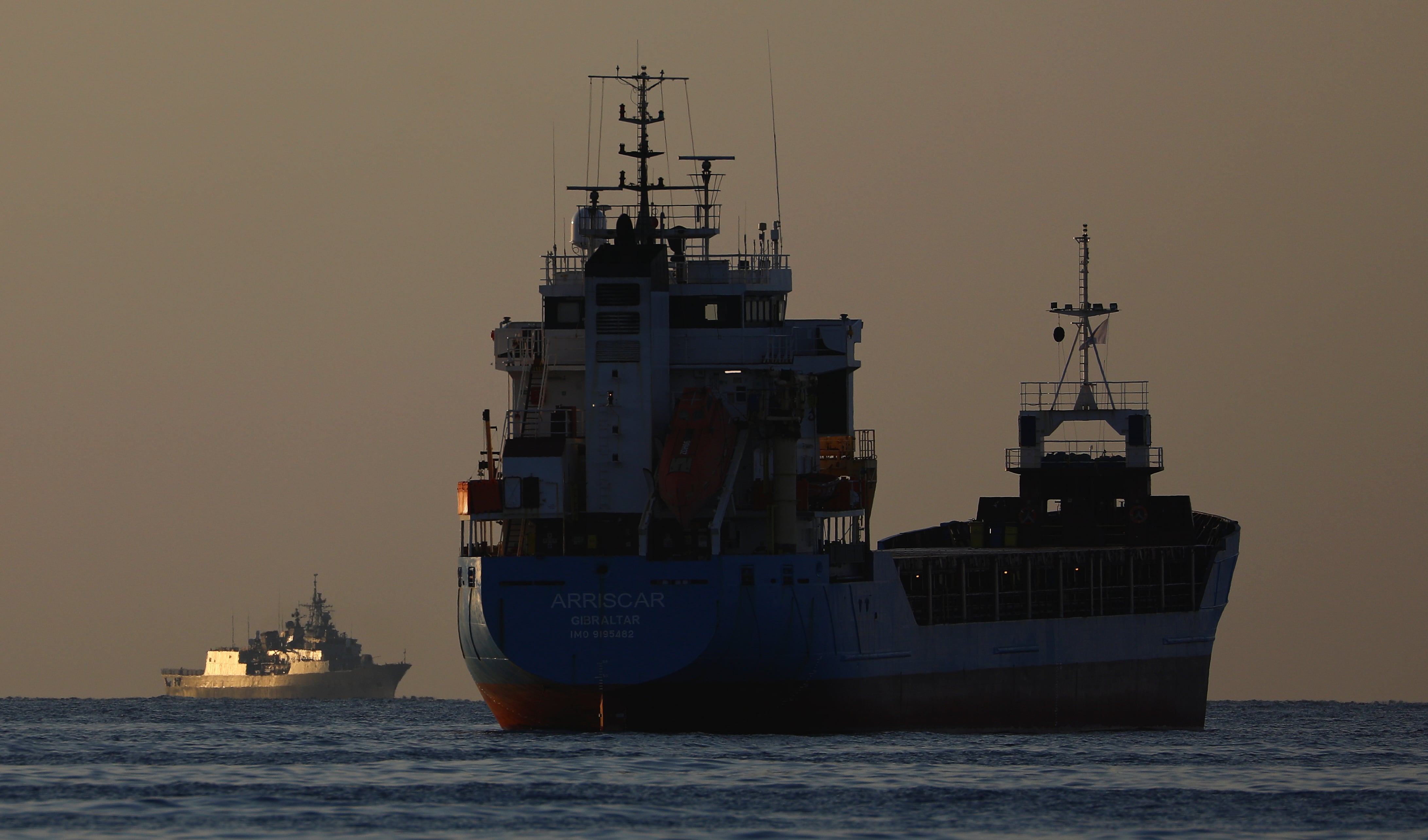
The deployment also positions assets that would be needed for any potential operation similar to France’s maritime evacuation during the 2006 Lebanon War, said Chihaia.
France has more than 400,000 citizens in the Middle East, more than any other European nation and compared with an estimated 300,000 British citizens in the region. The two helicopter carriers and the frigates will allow France, together with other European countries, to organize evacuation and repatriation operations if necessary, according to Macron.
The French president said late March 3 he ordered the carrier strike group to sail to the Med from the Baltic and northern Atlantic, a trip of around 7,000 kilometers by sea, then boarded the Charles de Gaulle off Cyprus six days later. The nuclear-powered flat top was carrying 20 Rafale jets, three E-2C Hawkeye airborne early warning aircraft and three helicopters, according to the president.
“Few navies are capable of doing what you did, and you did it at a sustained pace, and in an exceptional maneuver,” Macron told troops gathered in the hangar of the Charles de Gaulle, saying their presence demonstrated both France’s power and that of Europe.
The Italian frigate Federico Martinengo and the Spanish frigate Cristóbal Colón joined the carrier strike group on Tuesday, according to the French Navy. The Dutch air defense and command frigate Evertsen got the government go-ahead to participate in defense operations late Monday after escorting the Charles de Gaulle from the northern Atlantic.
Meanwhile, the U.K. Royal Navy destroyer Dragon set off from Portsmouth on Tuesday to head to the Mediterranean, a week after the Ministry of Defence said it was deploying the Type 45 vessel, with the government coming under fire for the delay and the limited scale of the deployment.
U.K. Parliament’s Defence Committee noted a “considerable gap” between international rhetoric and the reality of U.K support to the U.S. and regional partners, saying the situation underlined “longstanding and grave concerns, which we share, about whether the Royal Navy has sufficient capacity and resilience to respond effectively to a crisis at a time of worsening global security.”
Meanwhile, with the deployment to the Eastern Med, the French Navy had 19 of its 23 main surface vessels at sea, according to a count by specialized publication Mer et Marine. The Navy declined to confirm specific numbers, describing the deployment only as “large-scale,” with the forces constantly adapting their posture in response to threats.
The French Navy targets an 80% availability rate for its vessels, and maintains double crews for its major combatants to keep operational rates up.
Both France and the U.K. had already sent additional fighter jets and air-defense assets to the region, ahead of their warships. The naval deployment could participate in “these purely defensive missions,” Macron said on Monday. “We stand by our friends and our allies.”
France is the only European country able to carry out such a naval operation, with the British no longer capable of doing so and the Germans unwilling to, former French President Francois Hollande said in a TV interview on Monday. He said it’s important that France can protect its assets and citizens in the region, and deploy an aircraft carrier to help ensure the security of its partners.
The U.S. is increasingly seen by policymakers in the Gulf states as a net liability, with “serious questioning of the utility of the U.S. security umbrella,” Hasan Alhasan, a senior fellow for Middle East policy at the International Institute for Strategic Studies, said in a webinar on Monday. He said the U.S. has now twice dragged the Gulf states into a confrontation with Iran they did not want.
There’s also “quite a bit of disappointment” of how the U.S. seems to have made reduced focus on defending the Arabian Peninsula to prioritize defense of Israel, according to Alhasan, He cited further unhappiness with both America’s strategic rationale and the operational effectiveness of its defense of Gulf Cooperation Council partners and preemptive strikes on Iranian capabilities.
“I expect a long term strategic rethinking of the U.S.-GCC relationship if and when this war ends,” the IISS researcher said. “It’s quite interesting to see that certain European countries have been forthcoming, the U.K., France, Italy and others, in lending some assistance. So there might be a greater willingness to engage there.”
Alhasan said there’s additionally disappointment with other partners, especially in Asia, some of which have yet to condemn the Iranian attacks on Gulf states, “so I suspect there will be a 360 degree rethinking of GCC foreign relations once we are out of this present conflict.”
Regional perception of the U.S. as a reliable ally started to change in the early 2010s, with the Iran nuclear deal in 2015 “really a betrayal for the Gulf capitals,” said Camille Lons, a policy fellow at the European Council on Foreign Relations, in the Collimateur podcast. The Americans negotiated the deal without real consultation or taking into account the interest of the Gulf countries, she said.
The Gulf countries have bought “extremely sophisticated,” expensive systems from the U.S., but are concerned that the Americans will prioritize the defense of Israel, which is “somewhat what is happening,” according to Lons. With questions around the number of available air-defense interceptors, there is a risk for Gulf states “to run out of stocks fairly quickly.”
Macron said on Monday the French Navy deployment “demonstrates France’s desire to contribute to de-escalation, to the safety of our citizens, to the safety of our partners, and the freedom of navigation and maritime security.”
“It’s important to be able to stand alongside the countries in the region with which we have defense agreements, and which may be undermined by what is happening,” Macron told gathered crew on the Charles de Gaulle.
The deployment shows France’s capability to act independently from the Americans, contribute to defense in the Middle East and be a reliable partner, unlike the U.S., whose war is hurting the interests of its allies in the region, according to Foucher. While Israel is well protected, that’s “much less” the case for the Gulf states, she said.
“The fine line Macron is walking is that we’re not coming in with the heavy-handed approach of the Americans,” Foucher said. “There is only one risk, that we get bogged down.”
“The broader stakes are those of geopolitics and credibility towards our partners,” Foucher said. “It’s really about positioning France as one of the most important military powers in the world. To position France, not as an alternative power, because we can never replace the Americans, but as having a shared vision of the region that is not the same as the Americans.”
France will contribute two frigates “over the long term” to the European Union-led Aspides mission to secure shipping in the Red Sea, according to Macron. The country is also preparing a mission with both European and non-European partners to escort container ships and tankers to “gradually reopen” the Strait of Hormuz, once the hottest phase of the conflict is over, the president said.
France already leads a monitoring mission in the Strait of Hormuz to protect trade there, and if a military operation to support opening the strait does get underway, Macron could take credit for acting to keep down the cost of living down in France and elsewhere, said Ed Arnold, a senior research fellow at the Royal United Services Institute.
Deploying the carrier group deeper into the Middle East and towards Hormuz is risky, with traffic in the strait congested and due to Iran’s capabilities, according to Arnold. If France wants to stick to providing defense support to allies, it can do that from the Eastern Mediterranean, he said.
Iran has a large number of cheap aerial drones and unmanned surface vessels that make the Strait of Hormuz a riskier operating area than the Red Sea, and those risks will persist after the end of hostilities, according to Chihaia at the EPC.
On the upside, France’s deployment bolsters deterrence by showing Europeans can naval power and are willing to engage, while lessons learned from deploying such a large force to the region will be “hugely useful” for any potential future conflict, Chihaia said.
Arnold at RUSI said deploying forces into an area where there is danger but also a lot of support from allies is critical to building up experience, especially at the sailor level. While European navies have been shooting down drones in the Red Sea, “that’s a long way from the Falkland years in terms of operational and fleet experience,” he said.
With the French defense staff considering a larger war with Russia possible in coming years, the naval deployment strengthens France’s strategic posture as a military power, according to Foucher at FRS. In a hypothetical future conflict, there will be the question of the alignment of the countries in the Middle East, she said.
“If there is a war with Russia in the future, who in the Middle East can we count on?”
Rudy Ruitenberg is a Europe correspondent for Defense News. He started his career at Bloomberg News and has experience reporting on technology, commodity markets and politics.



-3.png)