
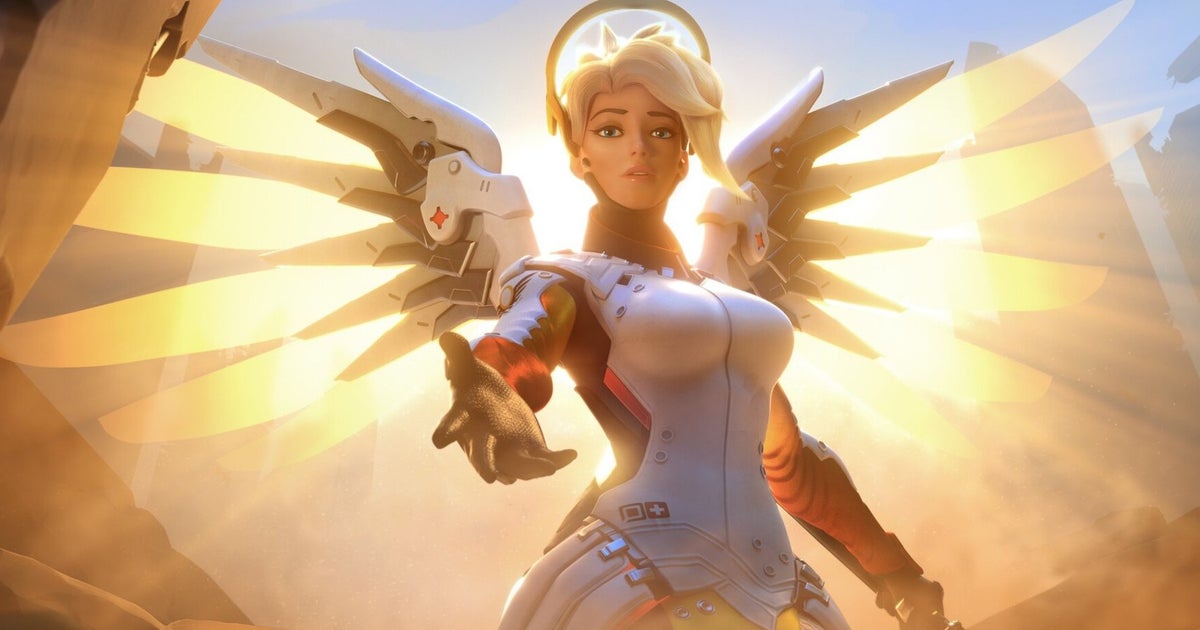
Jeff Kaplan, a former Blizzard designer renowned for leading the creation of Overwatch, has shed more light on arguably Blizzard's biggest failure: the cancelled massively-multiplayer game Titan.
Speaking on the Lex Fridman podcast, Kaplan described a project that was out of control and bankrolled in anticipation of success whereas in reality, it had no clear plan. "The hubris of Blizzard," Kaplan described it at one point during the interview. "It was a disaster."
Kaplan said Titan's development began not long after World of Warcraft's initial, stratospherical success, partly from a fear "WoW wasn't going to last forever". Blizzard believed that success would only last five years and then fade away, Kaplan said, "and the studio would be in real trouble if we didn't have another massively multiplayer online game waiting in the wings".
In late 2005 or early 2006, Titan talk began, and a team - led by Rob Pardo - began to gather to create ideas for what the next game would be. Kaplan, at the time, was busy trying to ship World of Warcraft's first expansion The Burning Crusade, but he was being pulled into design meetings anyway.
The idea for Titan, Kaplan said, was for it to take place on a future version of Earth where players would play as secret agents. By day, you'd have a job, "and by night they went off and did cool secret agent stuff". "The secret agent stuff was very first-person shooter but [with] over-the-top abilities like you would see in Overwatch, because that's where they would come from. And [in] the by day stuff we were going to let you run businesses. We took a lot of influence from Animal Crossing, Harvest Moon, The Sims." Blizzard apparently hired a former Sims creative director Matt Brown to work on the game.
You were going to be able to build a house and live in neighbourhoods, Kaplan added - perhaps this is where World of Warcraft's recent housing idea for neighbourhoods originated - and the big technical dream was to have all players play together on one gigantic server. "It was a one server, one world game," Kaplan said. World of Warcraft, by comparison, is separated into server 'shards' - smaller servers with single-digit-thousand populations, or thereabouts.
"And the world was massive," Kaplan said. There was Bay City, a kind of San Francisco; there was Hollywood; "and then we had to build all of California between that". They also wanted other cities from other countries such as Cairo and London. You can see a lot of these places in Overwatch today, which I'm sure is not a coincidence: Overwatch was built from the wreckage of Titan.
"The game had driving in it - like full blown [Grand Theft Auto]-style driving," Kaplan added. "It was such a gargantuan, huge undertaking, with a brand new engine, a brand new team, a brand new IP, which we really wrestled over, trying to figure out are there aliens, are there not aliens?" This alien debate characterised the project as a whole: lots of questions but few answers.
"The fast-forward part of that is we shut it down in 2013," Kaplan said. "That was one of the most painful development processes that I've ever been a part of. Probably deep into 2009, I knew that the game, in its current form, could never ship and would never exist. And by 2010, after numerous times trying to convince the powers that be that this game is not going to happen, it's in trouble... I remember going to Mike Morhaime in 2010 - and you're going to the CEO and Blizzard was a big company - and I'm like, 'You've got to shut us down; we're just going to burn money.'
"Ultimately, the failure of Titan lies with leadership, team leadership, myself included." -Jeff Kaplan
As far as Kaplan is concerned, the project failed in every area - in art, engineering and design - and that's not because the art wasn't good enough, but because there was no "cohesion", "so the art looked like it could come from 10 different games". "It was a multifaceted failure for many reasons," he said. And that was partly his fault. "Ultimately, the failure of Titan lies with leadership, team leadership, myself included. There's just no getting around that."
It should have been proved as a concept with "the smallest group possible" using whatever makeshift assets and engine parts were at hand, he said. Prove it quickly and cheaply, and then build it. Instead, a huge team was hired in anticipation of it coming together, and in anticipation of success. "Titan was the hubris of Blizzard in that era at its height of... We were over being hurt about World of Warcraft and 'I don't know if people are going to like it', Kaplan said, "and we were now in the era of 'we made World of Warcraft, we can do no wrong, this next thing is going to be the best ever'."
In 2014, Titan was cancelled, costing Blizzard something like $83m - a figure Kaplan nodded to during the interview. It was at this point that Kaplan formed a small team to build what would become Overwatch from what remained.
But this isn't the first we've heard about Titan, nor is it the first time Kaplan has talked candidly about it, having previously called Titan an "utter failure" back in 2016. Notably and most recently, Jason Schreier's insider book on Blizzard, Play Nice, devoted a chapter to Titan, revealing more about the conceptual ideas, and more about why it went wrong.
Schreier's book - I have a copy here - said there were two competing ideas for the game and two competing personalities leading it: Rob Pardo and Chris Metzen - both untouchable, superstar developers at Blizzard. Rob Pardo since left the company but Metzen returned in 2022 and remains there now.
Metzen apparently favoured a superhero-style idea of "godlike figures duking it out in the skies and streets" for Titan, whereas Pardo favoured the secret agent idea. The two designers clashed and apparently argued openly, resulting in Metzen leaving and returning to the project several times, which caused more confusion and chaos. Pardo was also apparently spread thin, overseeing many other projects at Blizzard, meaning he was only sporadically available to the Titan team.
Ultimately, Blizzard couldn't work out a way to blend the Sims-like daytime part of the game with the action-packed nighttime, and one spring morning in 2013, Pardo announced the game's cancellation to the team. Pardo had apparently become a divisive figure at the company by then, and after a sabbatical was asked to resign in summer 2014 by CEO Mike Morhaime, Schreier's book said.
Jeff Kaplan left Blizzard in 2019, under pressure to have Overwatch 2 return Overwatch to mega-success after the expensive Overwatch League eSports misfire. Kaplan actually had a three-game plan for Overwatch, Schreier's book said. Game-one would introduce the world with a tight competitive idea, which it did; game-two would introduce PvE, which it tried to do but it didn't work out; and game-three would be a full-scale MMO, like the Titan project it grew out of. That idea has since been abandoned, though, in favour of one Overwatch game - a PvP game that will evolve each year with expansion-like releases. The first of these, earlier this year, rejuvenated Overwatch.
Kaplan's reappearance in the public eye coincides with the announcement of his new studio Kintsugiyama and new game The Legend of California, an open-world action-survival shooter set on "the mythical island of California" during the gold rush era. "Explore a vast, untamed frontier and forge your legacy alone or with friends," reads the game's Steam description. It's being published by Mike Morhaime's newish company Dreamhaven.





-3.png)