
PARIS — On the edge of a meadow in western France, Gen. Benoît Desmeulles moves between two closely-parked armored personnel carriers tucked against a cover of trees and shrubs to reach his makeshift office, a patch of grass covered by a tent and multi-spectral camouflage netting.
It’s war, France is in charge, and Desmeulles for the first time is deploying the new mobile command structure of the French 1st Army Corps in its full configuration, as part of the Orion 26 exercise.
“Welcome to CP1,” says Desmeulles, taking a dark metal chair at a scuffed green-topped table, from where he oversees some 120,000 troops in the exercise as commander of the army corps.
Command Post 1 was set up in a few hours the day before, centered around six APCs packed with computing and communications gear, and will relocate shortly to follow five divisions maneuvering eastwards through ‘Arnland,’ a fictional country in the exercise suspiciously shaped like France.
With Orion 26, France is validating its ability to lead a corps-level European force in high-intensity conflict, acting as framework nation at a time when the United States is pushing NATO allies to take on more of their own defense. In the exercise, the 1st Army Corps commands French, Polish, British, Italian and Spanish divisional headquarters.
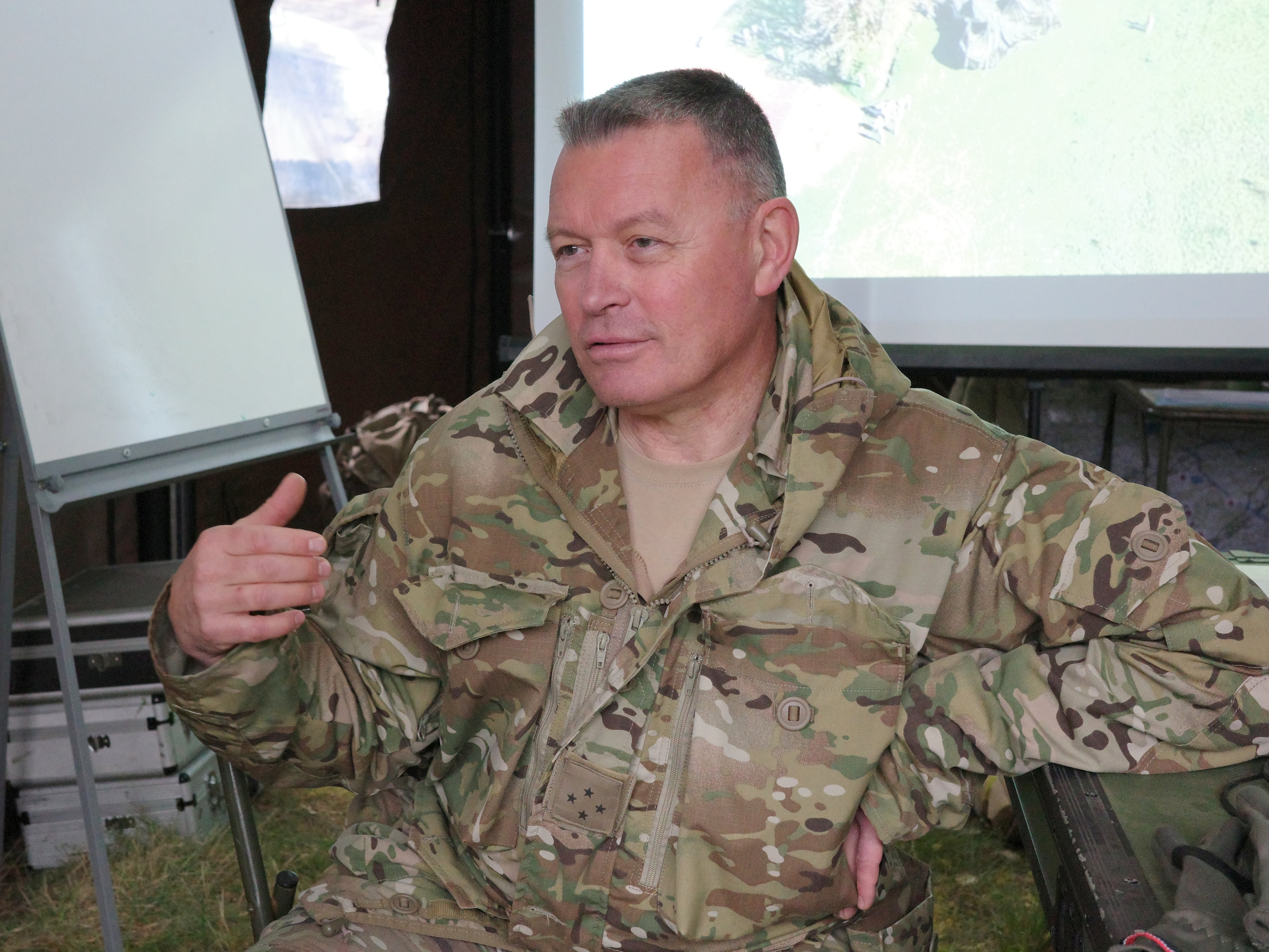
Desmeulles is testing a tiered command structure with a mobile forward post some 80 to 100 kilometers from the engagement zone, deployed under armor for mobility and survival. It’s a departure from NATO’s usual fixed corps commands in the rear, and designed to optimize the observe-orient-decide-act (OODA) loop for decision-making.
The small forward command post allows commanders “to be in contact with the divisions, to be as close as possible to the engagement zone,” Desmeulles said in a briefing with three reporters on April 11 at the Montmorillon training camp. “Hence this remilitarization, these armored capabilities, survivability features.”
A second command node farther back provides host-nation support and logistics, with a data-heavy headquarters in Lille in northern France.
Desmeulles, wearing combat fatigues, jokes one thing gained with the new setup is “a lot less hassle,” with about 50 people at the mobile headquarters instead of 500.
Ukraine has been a major source of reflection and inspiration but not a template for the rethink, with Desmeulles saying he also looked at the Gulf Wars and World War II. “We mustn’t lose sight of the fact that one day we might be engaged in something completely different.”
The 1st Army Corps general, in a previous command at the 11th Parachute Brigade, already worked “to put an end to these command posts that don’t move, that can’t move. That was the same logic.”
In Ukraine, distance no longer protects command and control, creating a need for mobility, dispersion and “digital hygiene,” Ukrainian Maj. Gen. Volodymyr Horbatiuk said in a Modern War Institute interview this month.
U.S. Army Lt. Gen. Curtis Buzzard, who helps coordinate Western aid to Ukraine, said in the same interview the forward line “is so lethal, but yet commanders have to get out there to feel and understand what’s occurring on the battlefield.”
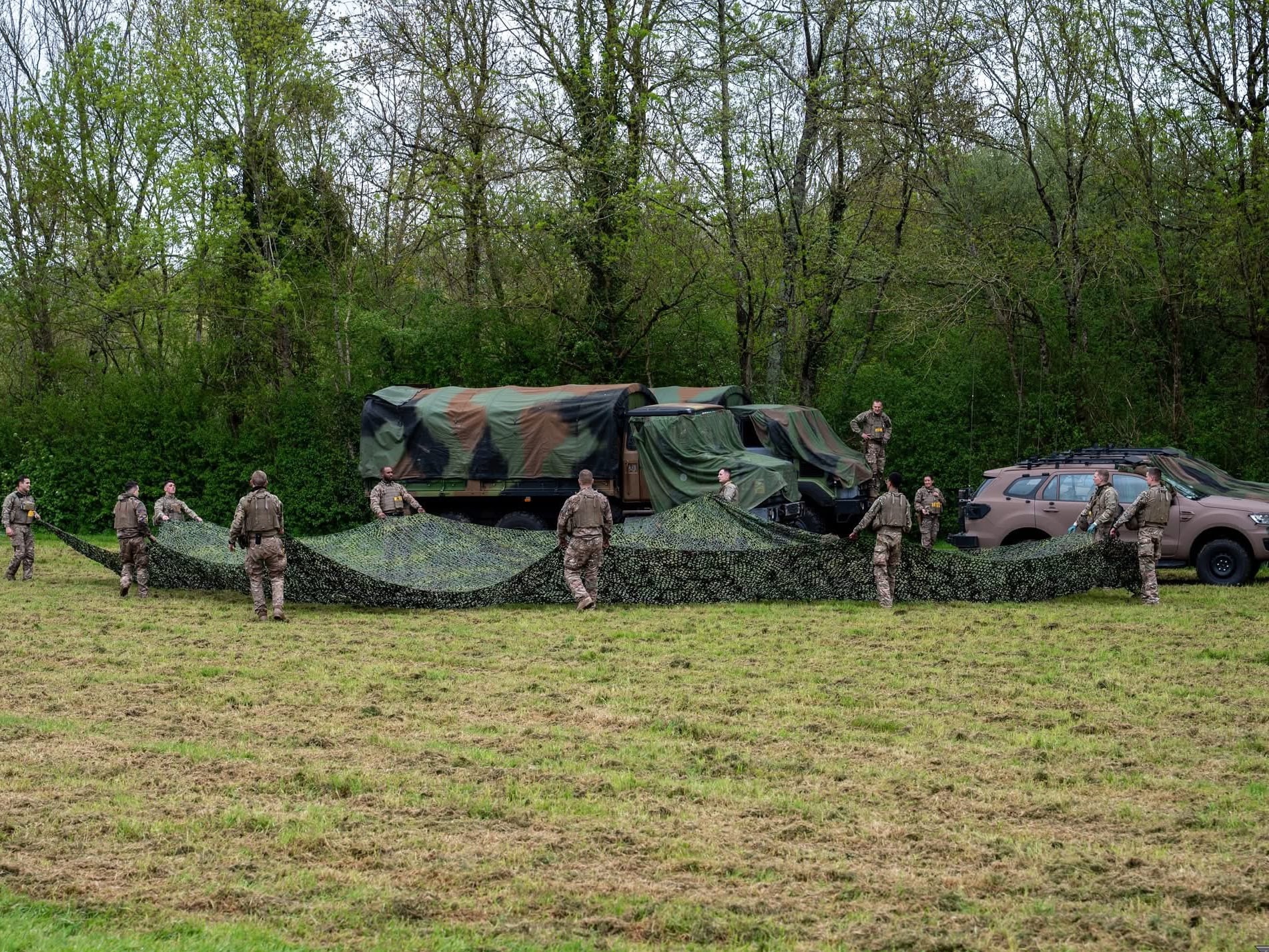
Setting up CP1 under cover takes about 20 minutes, and two hours with improved camouflage and a defensive perimeter, according to Capt. Charles of the 41st Signal Regiment, attached to the corps. He said a challenge of the command overhaul was fitting the armored vehicles with the required kit, in the venerable Véhicule de l’Avant Blindé for now and the new Griffon APC at a yet-to-be-determined date in the future.
“The main thing we’ve gained is the ability to be as close as possible to the divisions leading the battle,” Desmeulles said. “As corps commander, that to me is the most important. If I were at war, I’d be with the divisions rather than here to see how things are going. The structures in place before didn’t allow for that at all.”
Desmeulles said Orion 2026 is the first tactical deployment of NATO command networks, taking devices, networks and data flows usually confined to fixed buildings into the field. He recalled the fixed command compounds of past NATO deployments, with the International Security Assistance Force in Afghanistan “a city in itself; it was out of the question to imagine it moving.”
“The threat was different. Now, we’re preparing to fight a different battle, so the tools evolve.”
The forward post is linked to CP2 in the rear and CP3 in Lille through a hybrid network of satellite, radio and mobile networks, “because none of this makes any sense unless it’s connected,” said Desmeulles. The corps headquarters in the 17th-century Lille citadel houses about 90% of the command staff and the main data infrastructure, allowing the forward posts to remain mobile.
France in coming months will add its own “true distributed working capability” with artificial intelligence-enabled data processing, similar in function to the U.S. Project Maven, according to Desmeulles.
In addition to armored mobility, the new forward command relies on anti-drone measures and electronic warfare to survive. For Saturday’s deployment, the 41st Signal Regiment set up a decoy command post, including fake emissions.
“We’ve strengthened the military aspect,” Desmeulles said. “At a NATO training center, people are in buildings, they work with phones, at night they go to a hotel. It’s a different approach that puts us a little ahead of other NATO units in terms of the command post, a commitment to really create a tool that can be realistically deployed.”
As the 1st Army Corps practices field deployment, there’s still work to be done on electromagnetic emissions and decoys, according to Desmeulles.
Three lieutenants from reconnaissance, signals and artillery regiments acting as the opposing force said they found the forward command post with relative ease on Thursday, first tracking electromagnetic emissions and then using a Parrot drone for visual confirmation.
On Saturday, the search was more difficult, with the red team losing time due to tracking a decoy command post.
During Orion 26’s offensive phase, Desmeulles places himself closer to the front to support division commanders “who, like any leader, suffer from the loneliness of leadership,” saying his presence provides reassurance.
France is one of a handful of NATO countries with fully national corps headquarters that can be integrated into alliance operations. The corps deployed from Lille to Dunkirk by A400M transport aircraft and barge, then onward by roll-on/roll-off ship to La Rochelle on the Atlantic coast.
As the exercise scenario escalates to a larger-scale conflict, integrating the deployed French-led corps into a NATO structure for the first time is “technically quite complex,” according to Desmeulles. Orion 26 includes parallel French and NATO command chains to expose the friction between national sovereignty and alliance operations.
There’s no actual mass troop movement through France, with divisions represented by their commands, and combat simulated using software from French firm Masa Group, which Desmeulles described as “somewhere between Call of Duty and full-scale global strategy games.” A next phase this month will see 12,500 French troops deploy in a live exercise including wet-gap crossings.
After decades of counterinsurgency focus, the French Army has resumed training for high-intensity warfare, and the country aims to field a division ready for war in 2027 and a combat-ready corps by 2030. Reflecting the changing times, the 1st Army Corps was renamed from Rapid Reaction Corps-France in January, reviving a Cold War-era designation.
“We are now envisaging deploying the entire army corps for a much shorter period, but in a way that is obviously far more intensive, with real high-intensity combat,” Desmeulles said. “This shift from one operational framework to another has in fact led to a shift in the approach to command posts, in how we train, and in what an army corps actually is.”
The command-post overhaul positions France as a driver of NATO land force transformation, according to Desmeulles, who says he’s seeing “a lot of interest” from fellow NATO commanders.
“Though everyone agrees with the idea, only we have made the effort to implement it,” the general said. “We’ve invested money to completely reorganize the army corps command structure. Before we started our transformation, by and large everyone agreed with the principle. Now that we’ve done it, everyone sees that’s the direction we need to go.”
The 1st Army Corps can deploy without U.S. support, with sovereign communications, according to Desmeulles, who said the biggest capability gap for a European or French army corps deploying without American support would be firepower. French lawmakers for years have raised concerns about a capability gap in rocket artillery and a lack of sufficient howitzers.
“I’m not saying it would be as easy,” Desmeulles said. “But overall, we’re good.”
Transforming corps-level command took less than 18 months after putting the plan on paper, and while CP1 is only a small part, “it’s one that is quite representative of the evolution we’ve led,” according to Desmeulles. He said changing the command structure meant transforming everything from operating procedures to equipment and the people serving.
“It’s easy to say, ‘We’re going to set up three CPs, that’s it, piece of cake.’ And I grab a checkbook and buy vehicles,” Desmeulles said. “That’s actually the easiest part. The real challenge lies in how you’re going to implement this change across all areas.”
Asked about the strategic signal of Orion 26, Desmeulles responds the idea is simply to telegraph that France’s land forces are ready.
“Whatever happens, France has an army corps ready for deployment,” he said. “It’s not perfect, the firepower, all that. But in fact, it is deployable.”
Rudy Ruitenberg is a Europe correspondent for Defense News. He started his career at Bloomberg News and has experience reporting on technology, commodity markets and politics.


-3.png)