

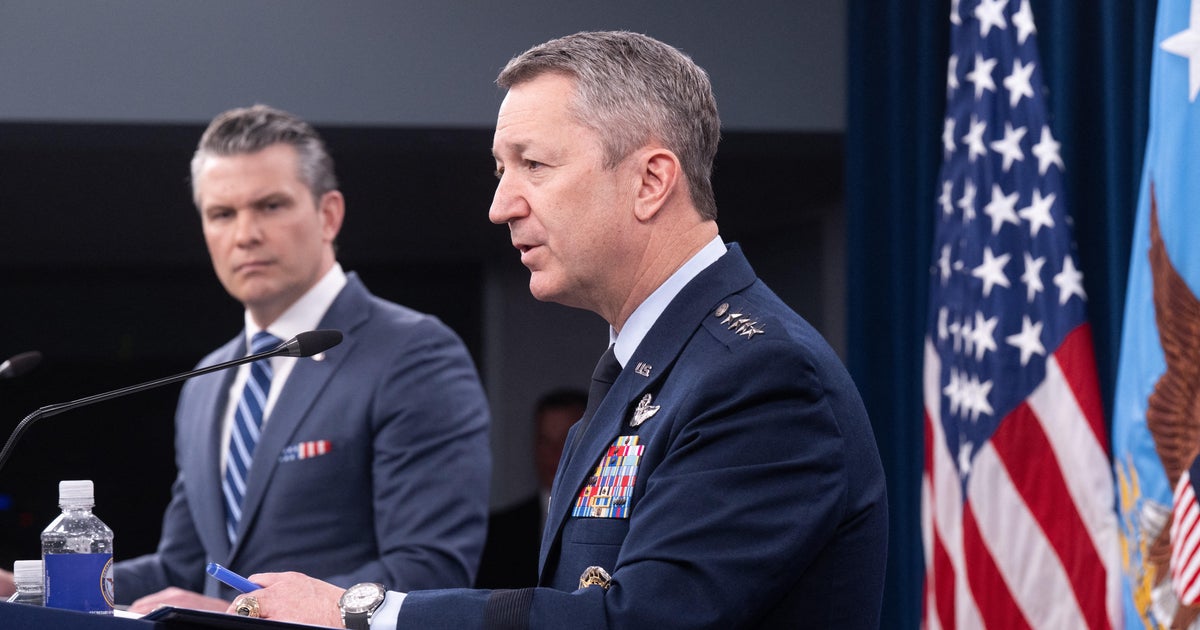
Defense Secretary Pete Hegseth and Chairman of the Joint Chiefs of Staff Gen. Dan Caine said at a news conference on Thursday that U.S. forces stand at the ready if any ships do not comply with the blockade in the Strait of Hormuz despite the two-week ceasefire in the war with Iran.
"If you do not comply with the blockade, we will use force," Caine said.
Hegseth said that the U.S. will maintain the "successful blockade" of the Strait of Hormuz. Hegseth said the U.S. military can "make the transition" from this blockade to "major combat operations."
"We can make that transition again very quickly and even more powerfully than ever," Hegseth said. "At the direction of President Trump, the War Department will ensure that Iran never has a nuclear weapon, never. We prefer to do it the nice way through a deal led by our great vice president and negotiating team, or we can do it the hard way."
Caine said the blockade applies to all ships, regardless of nationality, heading into or from Iranian ports. Caine said that so far, 13 ships made the "wise choice of turning around" amid the blockade. He said that so far, the U.S. Central Command, or CENTCOM, have not had to board any particular ships.
The U.S. began enforcing a naval blockade on the Strait of Hormuz on Monday as Iran has sought to maintain its grip on the Strait of Hormuz and limit transits of the waterway, which normally carries one-fifth of the world's oil. The blockade is being enforced in the Gulf of Oman, immediately outside the Strait of Hormuz, a U.S. official told CBS News.
In response, Iranian officials have publicly threatened to sink American ships and close a second major waterway, the Red Sea. Meanwhile, transits of the Strait of Hormuz have remained well below pre-war levels since the ceasefire began.
Thursday's news conference comes just over eight days into a two-week ceasefire that jumpstarted negotiations to end the war. Iranian and U.S. negotiators did not strike a deal after talks in Pakistan last weekend, with major disagreements still lingering over Iran's nuclear program, but Mr. Trump has said there could be another round of talks in the next few days.
Hegseth continually pushed Iran to "choose wisely" to make a deal, saying "in the meantime, the War Department is locked and loaded."
Caine also emphasized this point, saying the U.S. joint forces "remains postured and ready to resume major combat operations at literally a moment's notice."
Mr. Trump posted on social media on Wednesday that Israel and Lebanon will speak as Israel has continued to hit Hezbollah targets as both the U.S. and Israel have insisted that Lebanon is not part of the tenuous two-week ceasefire that began on April 8.
"Trying to get a little breathing room between Israel and Lebanon. It has been a long time since the two leaders have spoken, like 34 years. It will happen tomorrow. Nice! President DJT" Mr. Trump wrote on Truth Social.
Lebanese and Israeli officials met this week in Washington, D.C., for their first direct talks in decades, and the two sides agreed to hold further negotiations, though Hezbollah rejected the talks.
Mr. Trump late Wednesday told Fox News the conflict is "very close to over" as he and Pakistan's leader suggest a new round of direct U.S.-Iran peace talks could be looming.
A senior U.S. official told CBS News on Wednesday the country "has not formally agreed to an extension of the ceasefire," but discussions are still ongoing. Iran has also acknowledged indirect talks. Pakistan has pressed for further negotiations.
It's unclear what will happen if the ceasefire lapses. Hours after the pause began last week, Hegseth said the military was "prepared to restart at a moment's notice." Israeli Prime Minister Benjamin Netanyahu also said Wednesday his country is prepared to resume fighting if needed. But Mr. Trump has expressed optimism, saying Tuesday the war is "very close to over."
One complicating factor is Israel's continued strikes on Hezbollah and its occupation of a wide swath of southern Lebanon to target the Iran-backed militant group. More than 2,100 people have been killed in the Israeli offensive, according to Lebanon's health ministry, which does not distinguish between civilian and combatant casualties. Iran has insisted that those strikes aren't allowed under the two-week ceasefire deal, which the U.S. and Israel deny.
The war is also testing the U.S.'s alliances. Mr. Trump has lashed out at NATO for not getting involved in the Iran conflict and weighed leaving the organization, saying Tuesday that NATO "wasn't there for us, and they won't be there for us in the future!"




-3.png)