

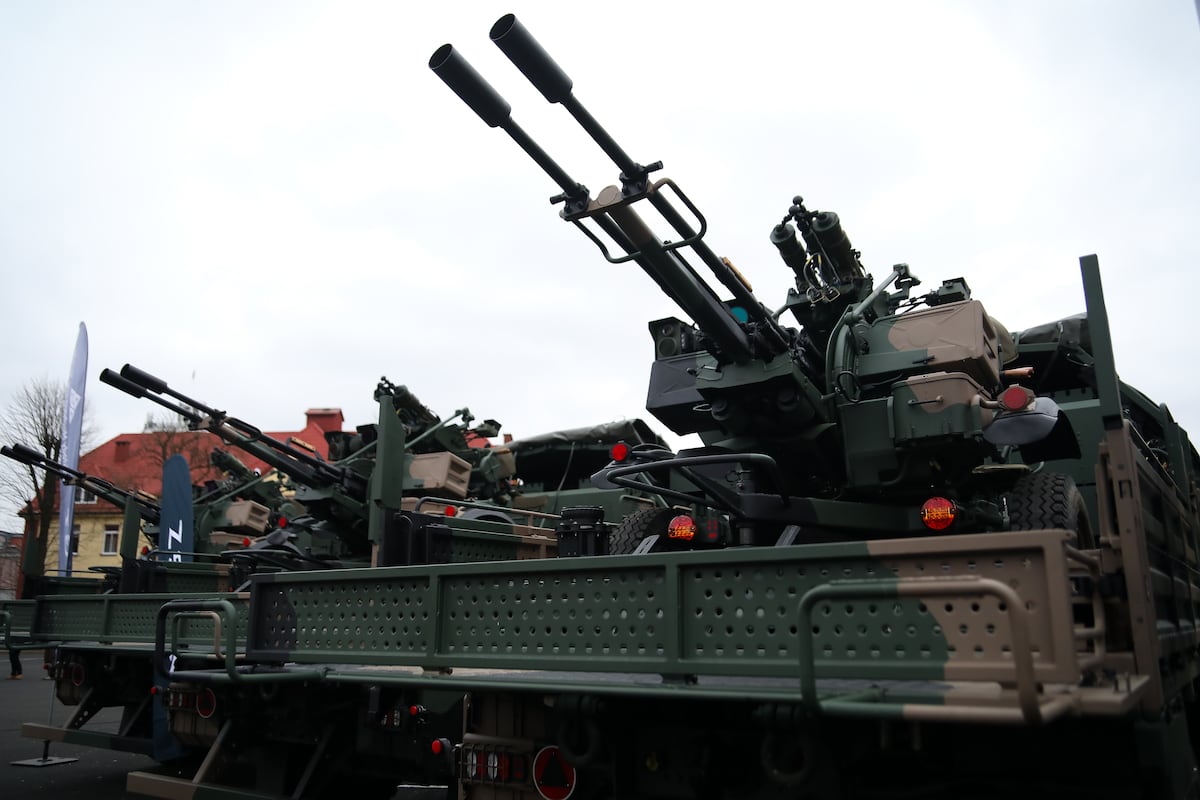
WARSAW, Poland — Poland’s Ministry of National Defence has signed a deal with a consortium comprising Norway’s Kongsberg Defence & Aerospace and Polish state-run defense group PGZ to acquire counter-unmanned aerial systems (CUAS) that will protect the country’s airspace.
The purchase comes in response to incursions by Russian drones that Moscow has perpetrated against Poland alongside Russia’s ongoing invasion of Ukraine.
Signed on Jan. 30 in the presence of Polish Prime Minister Donald Tusk and Władysław Kosiniak-Kamysz, who is deputy prime minister and defense minister, the deal paves the way for the development of the San anti-drone system whose value is estimated at around PLN 15 billion ($4.2 billion). Deliveries of the first components of the system are scheduled to begin in 2026.
“We are talking about 18 anti-drone batteries, 52 firing platoons, 18 command platoons, 703 vehicles, of which around 400 are based on the Jelcz [military truck platform] and 300 are based on the Legwan [light reconnaissance vehicle]. All of this means that we will be able to react in an extremely effective way against the threats that originate from the east,” Kosiniak-Kamysz said during the official signing ceremony.
In his remarks, the deputy prime minister referred to last September’s violations of Polish airspace by Russian unmanned aerial vehicles (UAVs). The drone threats had triggered action by the Polish and allied air forces which included scrambling F-35 fighter jets to shoot the the drones down.
“The night of September 9-10, 2025, when our airspace was violated, when Russian unmanned aerial vehicles first appeared over NATO territory, was a turning point,” Kosiniak-Kamysz said. “It was a moment when we all wondered what else could be done. Research on this equipment took many months: integration, combining all the elements into one well-functioning system.”
He described the San suite, named after a river in eastern Poland, as a “vast and multi-threaded system, created by both [PGZ] … and its partners: APS from Gdynia and Kongsberg from Norway.”
The value of Kongsberg’s share of the deal is around NOK 16 billion ($1.66 billion). In a statement, the Norwegian company said the batteries that are to be supplied to Poland’s military will comprise a wide range of effectors, including 35mm, 30mm and 12.7mm guns, as well as missiles, interceptor drones and other solutions. The system is based on Kongsberg’s Protector family of weapons, including the Medium Caliber Turret (MCT30) and the Remote Weapon Station, the producer said in a statement.
The acquisition “confirms Poland’s position as a regional hub for counter-drone innovation and strengthens Kongsberg’s positions as one of Europe’s leading providers of anti-drone solutions,” said Eirik Lie, the president of Kongsberg Defence & Aerospace.
Tusk said Kongsberg’s participation in the consortium indicates the Polish government “not only appreciates the competencies of our Norwegian partners, but also considers it an element of the new security architecture that Poland has initiated.”
The prime minister said that, in the aftermath of Russia’s attack against Ukraine, Poland seeks to strengthen its military cooperation with the Baltic States and Scandinavian countries. He also pointed to Poland’s selection of the A26 Blekinge submarine, a design offered by Sweden’s Saab, in November 2025 as “a practical expression of this new security architecture.”
PGZ said in a statement the majority of the components of the San system, with a share of around 60%, is to be supplied by companies that are part of the Polish group.
“Deliveries of the entire system are expected to be completed 24 months following the signing of the contract,” PGZ said.
The SAN program represents a key initiative to boost Poland’s air-defense capabilities. The Polish ministry has also ordered Common Anti-air Modular Missiles, or CAMM, as well as iLaunchers from European consortium MBDA. The weapons are part of the nation’s Narew short-range air defense system developed by PGZ. The ministry has also purchased Pilica+ very-short-range air defense batteries from the Polish defense industry.
The Narew and Pilica+ systems will complement the two Patriot Configuration 3+ batteries Poland purchased in 2018 under the Wisła mid-range air defense program, and the second phase of the program announced in May 2022 under which the country seeks a further six batteries of the system made by Raytheon.
Kosiniak-Kamysz said that, in total, Warsaw intends to spend around PLN 250 billion on bolstering its air defense capabilities which could make the effort the largest acquisition program for the Polish military in history.
“We are building another layer of the air defense system. We have the Wisła, we have the Narew, we have the Pilica, and we are now adding the San,” he said.
For 2026, the Polish government has earmarked a defense budget of some PLN 200.1 billion, up from PLN 186.6 billion a year earlier. This means the country’s military expenditure could capture more than 4.8% of Poland’s gross domestic product (GDP).
A large portion of the money for new military acquisitions, including the San program, is to be sourced from roughly €44 billion ($51 billion) in low-cost loans that Poland was awarded under the European Union’s Security Action For Europe (SAFE) scheme.
Jaroslaw Adamowski is the Poland correspondent for Defense News.








-3.png)